
“Screened” and “verified” can describe several different checks. A website may confirm an account holder’s identity, review experience, conduct a sample reading or monitor service concerns after approval. Knowing which process is actually described helps you choose a reader with clearer expectations.
For someone who values psychic guidance, screening can be useful information about the platform’s standards. It is not a universal credential, a promise that every reader fits every client or independent proof that every forecast will occur.
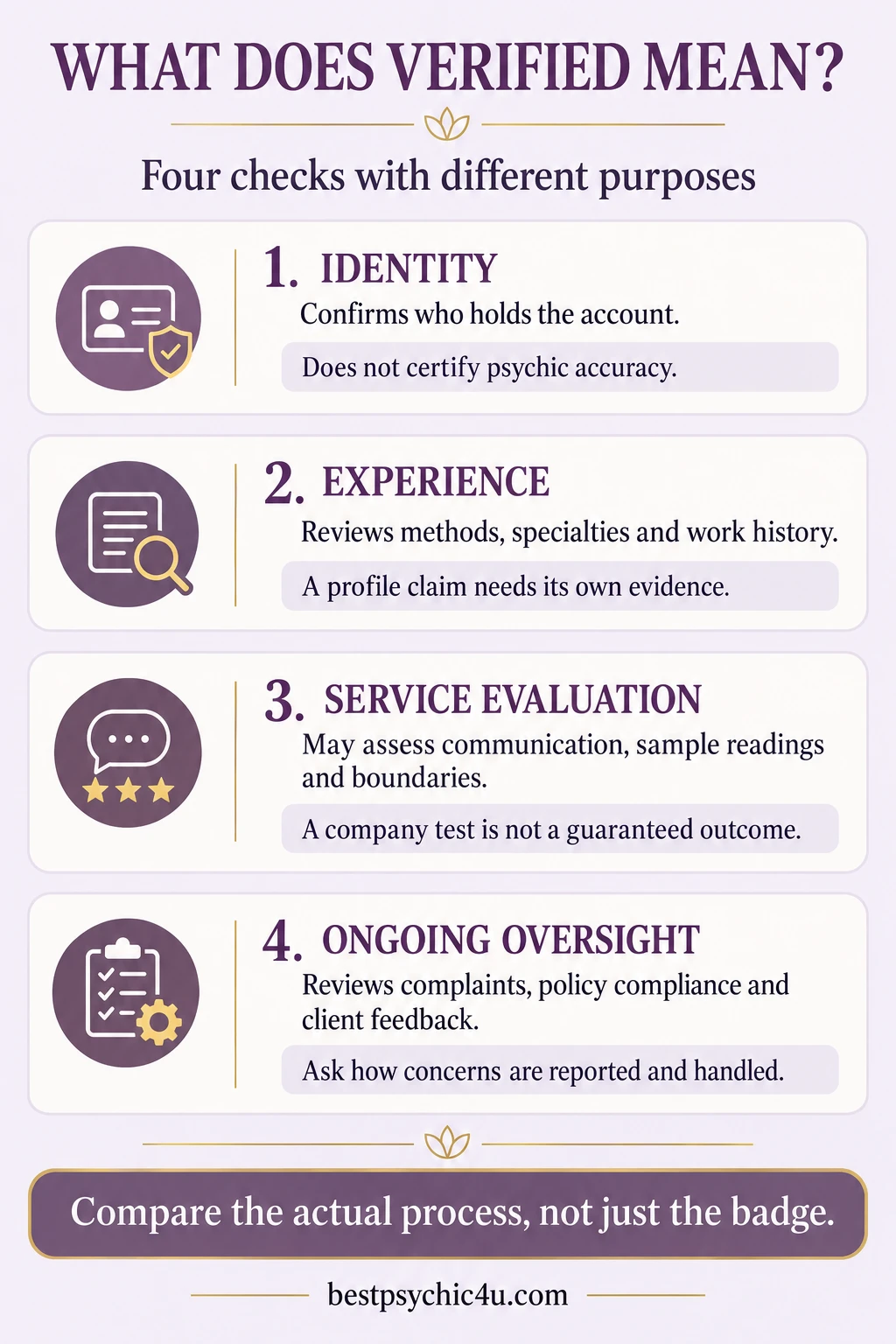
Read the infographic as text
- Identity: confirms who holds the account; does not certify psychic accuracy.
- Experience: reviews methods, specialties and work history; a profile claim needs its own evidence.
- Service evaluation: may assess communication, sample readings and boundaries; a company test is not a guaranteed outcome.
- Ongoing oversight: reviews complaints, policy compliance and client feedback; ask how concerns are reported and handled.
Compare the actual process, not just the badge.
Four published processes compared
The following provider pages were checked on 14 October 2026. These are the companies’ descriptions of their processes, with different criteria and circumstances; they are not comparable accuracy scores.
| Provider | Published initial steps | Ongoing or important distinction |
|---|---|---|
| PsychicOz | Application and experience review; applicant-dependent verification, interviews and test readings; professionalism and policy review. | Its description says stages can vary and that feedback or service concerns may inform ongoing reviews. |
| California Psychics | Phone interview, multiple test readings and a criminal background check are described. | The page also describes continuing reevaluation; its accuracy marketing is not an independent outcome guarantee. |
| Psychic Source | Application, prerecorded questions, a video interview with a live reading, contract and onboarding. | The recruiting page explains stages; client-facing professional standards also need to be read separately. |
| Kasamba | Identity and compliance checks, live mock readings, profile moderation and guidelines. | Its current page describes guidance and feedback-based review, with possible suspension or removal. |
PsychicOz: account for applicant differences
The quality page describes a general multi-stage approach and says requirements may vary with circumstances. It discusses reading approach, communication, boundaries and policy compliance. Do not turn “may” into a claim that every applicant completed every stage in exactly the same way.
California Psychics and Psychic Source: concrete interview stages
California Psychics describes a phone interview and several test readings. Psychic Source’s recruiting page describes prerecorded interview questions followed by a video interview that includes a live reading. These are specific processes you can investigate, rather than a vague “high screening” label.
Neither description gives you a directly comparable accuracy score. Acceptance percentages can depend on who applies, business needs and different evaluation criteria; they do not prove one platform’s predictions are more reliable.
Kasamba: use its current verification description
Kasamba’s current page describes identity and compliance verification, live mock readings and profile guidelines, followed by guidance and client-feedback review. Calling the platform simply a lightly screened marketplace would omit those published steps.
Also distinguish a platform evaluation from professional credentials. Kasamba’s member terms place responsibility on clients to verify credentials and qualifications. A spiritual advisor’s approval is not a substitute for checking a licence where a separate professional service requires one.
What about Keen, Purple Garden or another platform?
Check that provider’s own current application, verification and service-policy pages. Do not infer a weak process from a large directory, or a strong one from a smaller directory. A public page that does not expose a particular step does not prove the company never performs it.
Keep the distinction visible when comparing profiles. “Verified identity,” “completed sample reading” and “licensed counsellor” are different claims. Ask what a badge means rather than giving it a meaning the provider has not stated.
Four purposes of screening
Identity
Who controls the account? This does not certify psychic ability.
Experience and method
What does the applicant say they do, and which information supports that description?
Service conduct
How do they explain a reading, communicate uncertainty and respect a stopping request?
The fourth purpose is ongoing oversight: whether concerns, policy compliance and client feedback can trigger review after approval. Ask how clients report an issue and what records are useful.
Look for standards that matter during your reading
- No threats of harm if you refuse another purchase.
- Clear scope, price and format before payment.
- Respect for privacy, consent and your decisions.
- Room to disagree, clarify or end a session.
- No medical, legal or financial guarantees outside the reader’s role.
Our comparison of readings and counselling explains why spiritual and clinical services have different roles. A kind conversation does not by itself establish a professional qualification.
Feedback and complaints have their own limits
A review may reveal a specific communication issue, but a single mismatch is different from a documented policy concern. Read the details and keep service delivery separate from a future claim. A visible review is not a complete record of every support interaction.
If you have a concern, preserve the date, terms and relevant messages, then use the provider’s support process. You do not need to continue paying in order to raise a service or billing question.
Use screening alongside your own selection
Read the actual profile, choose a topic and format that fit, and confirm the total cost. Our spending-limit guide helps you plan a session. If you prefer writing, our live-chat guide covers format and privacy choices.
You can value a platform’s professional standards while keeping your own judgement. The useful question is not which badge sounds strongest, but what was checked, what remains uncertain and how you want to proceed.
Frequently Asked Questions
1. What does screened psychic mean?
It refers to a provider’s evaluation process, which may include different checks. Read the actual stages and requirements rather than assuming a universal standard.
2. Does identity verification certify psychic accuracy?
No. Confirming who holds an account and verifying a psychic prediction are different things.
3. Do all applicants complete identical steps?
Not necessarily. Providers may vary stages by circumstances or applicant; read the wording carefully.
4. What does PsychicOz describe?
Its quality page describes application review, applicant-dependent verification, interviews and test readings, professionalism, policy review and possible ongoing monitoring.
5. What does California Psychics describe?
Its published page describes a phone interview, multiple test readings, a criminal background check and continuing reevaluation.
6. What does Psychic Source’s recruiting process include?
Its page lists an application, prerecorded interview questions, a video interview with a live reading, a contract and onboarding.
7. What does Kasamba currently describe?
Its verification page describes identity and compliance checks, live mock readings, profile moderation, guidelines and feedback-based ongoing review.
8. Does a sample reading prove every future forecast?
No. A company evaluation is not a guarantee of every later reading or outcome.
9. Can acceptance percentages rank psychic accuracy?
No. Different applicants, criteria and business needs make those percentages an unsuitable direct accuracy comparison.
10. Does a larger directory mean less screening?
No. Directory size alone does not establish the evaluation process or its quality.
11. Does an undocumented step mean it never happens?
No. A public page may not describe every procedure. Ask the provider rather than drawing that conclusion.
12. Is platform approval a professional licence?
No. A spiritual advisor’s approval and a regulated professional qualification are different claims.
13. What ongoing standards should I look for?
Look for clear scope and charges, privacy, respectful boundaries, no fear-based pressure and a usable complaint process.
14. Does one poor review prove a policy violation?
No. A mismatch and a documented conduct or billing concern are different. Consider the detail and available records.
15. What should I do if a reader pressures me?
You can decline or end the session, preserve relevant details and use the provider’s support process without purchasing another reading.