

Why Leaving a Relationship is Hard
Leaving a relationship can be hard because it isn’t just about what is happening right now, but also:
- Shared memories.
- Emotional attachments.
- Future and shared plans.
- Fear of being lonely.
- Financial concerns.
- Family concerns.
Even when people know that something might feel wrong, they sometimes hold onto the relationship that they remember instead of one that they’re experiencing in the present.
This can create emotional conflict and confusion. There are some days that feel hopeful and like the relationship is repairing itself, while others feel tiring. This kind of inconsistency makes it hard to recognize when emotional damage has already become part of the relationship.
“Story of Us” Theory
One of the strongest parts of a relationship’s health comes from what researchers call the “Story of Us.” This shows how couples describe their relationship history, such as:
- How they met each other.
- What they like about each other.
- How they talk about challenges.
- The emotional tone that comes with their memories.
Couples that are happy often describe their story with humor, appreciation, and warmth, even when they’re talking about hard times. The memories that they have keep a balance, where there are negative experiences, but these experiences don’t erase the positive memories.
When you listen to unhappy couples, they tell a totally different kind of story. Their memories are ruled by resentment, emotional distance, and disappointment. The positive memories feel insignificant or distant compared to the negativity in the relationship.
Sign 1: Distant Positive Memories
One big sign of emotional disconnection is when the positive memories no longer feel emotionally available. Healthy couples are usually able to recall things like:
- Fun times they experienced together.
- Hard times they survived as a team.
- Small times of support or affection.
Even if the relationship is struggling, these memories that are positive feel emotionally real and peaceful.
When relationships are unhealthy, negativity rewrites the past, and people stop remembering why they love their partner, the happy times they shared together, and they start focusing on the hurt and disappointment. This can point to:
- Conversations that keep going back to old arguments.
- A hard time remembering the last happy moment.
- Feeling emotionally disconnected even when talking about positive things.
This usually shows that resentment is stronger than the emotional connection.
Sign 2: Appreciation Turns into Criticism
Healthy relationships usually have a strong sense of respect and appreciation. Even during difficult moments, couples still notice each other’s effort, strengths, and positive qualities.
In unhealthy relationships, criticism might start replacing admiration. Instead of feeling supported, one or both people start focusing more on flaws, mistakes, or disappointment. This can look like things like:
- Frequent irritation or sarcasm.
- Feeling emotionally criticized often.
- Rarely hearing encouragement or appreciation.
- Feeling judged more than supported.
Over time, this creates emotional exhaustion and distance within the relationship.
Sign 3: The Relationship Stops Feeling Like a Team
Healthy couples usually feel like they are working through life together, even when they disagree.
As the emotional connection weakens, that feeling of partnership starts to fade. Instead of thinking like a team, people begin focusing mostly on themselves and their own emotional survival. You may notice things like:
- Prioritizing personal happiness over the relationship completely.
- Feeling emotionally alone while still together.
- Treating conflict like something to win instead of solving.
This shift changes the emotional foundation of the relationship and can make even small problems feel isolating.
Sign 4: Emotional Connection Feels Missing
Strong emotional intimacy needs to have ongoing attention, curiosity, and communication.
Healthy couples keep learning about each other over time, including fears, goals, emotional needs, and personal stress.
In relationships that are disconnected, conversations often become surface-level and routine. Instead of there being emotional closeness, interactions start feeling functional. This can lead to things like:
- Feeling emotionally misunderstood.
- Feeling more like roommates than partners.
- Feeling disconnected from your partner emotionally.
Even when you spend time together daily, the relationship can still feel lonely.
Sign 5: Arguments Never Really Get Resolved
Conflict is normal in every relationship. The difference is whether those conflicts eventually lead to understanding and reconnection.
Healthy couples usually repair emotional damage after they have disagreements. Unhealthy relationships often stay stuck in the same cycles over and over again. You may notice things like:
- The same arguments happening over and over.
- Problems never feel fully resolved.
- Conversations escalating quickly or shutting down completely.
As time goes on, conflict starts feeling emotionally draining instead of it being healthy or productive.
Sign 6: The Relationship Feels Constantly Disappointing
One major sign of emotional disconnection is lasting disappointment.
This goes beyond occasional frustration. It becomes a consistent feeling that the relationship no longer matches what you hoped it would be emotionally. People may begin thinking things like:
- “This isn’t how I thought love would feel.”
- “I feel emotionally alone.”
- “We’ve changed too much.”
As time goes on, disappointment can turn into things like hopelessness about the future of the relationship.
Sign 7: You Don’t Feel Emotionally Safe Anymore
Emotional safety is one of the most important parts of having a healthy relationship.
This means feeling comfortable expressing emotions, being vulnerable, and making mistakes without fear of emotional punishment or rejection.
When emotional safety disappears, people often start holding back their real thoughts and feelings. Conversations may feel tense, unpredictable, or emotionally risky instead of feeling comforting and supportive.
Sign 8: The Relationship Feels Emotionally Exhausting
Healthy relationships require effort, but they also provide emotional support and connection.
In unhealthy relationships, people often start feeling emotionally drained more often than they feel happy and fulfilled. This can include things like:
- Constant emotional exhaustion.
- Anxiety around interactions.
- Feeling more relaxed when apart.
This doesn’t always mean love is completely gone, but it can mean the relationship no longer feels emotionally healthy.
Sign 9: The Future Stops Feeling Exciting
Thinking about the future can reveal a lot about how someone truly feels inside the relationship.
When you imagine long-term plans, growing older together, or continuing the relationship, does it feel hopeful or does it feel emotionally heavy?
People often sense things internally when something no longer feels aligned, even if they struggle to fully admit it.
Sign 10: Fear Becomes the Main Reason You Stay
Fear keeps many people in relationships long after the emotional connection has become weak. Common fears can include things like:
- Being alone.
- Starting over.
- Hurting the other person.
- Regretting the decision later.
But staying because of fear feels very different from staying because of love, emotional connection, and genuine compatibility.
Self-Reflection Quiz to Answer Honestly
Ask yourself these questions:
- Do I feel emotionally safe with my partner?
- Can I talk to my partner openly without fear of the talk escalating?
- Do I respect my partner?
- Do I feel valued?
- Do I feel understood?
- Are we growing together as a couple or apart?
- Am I staying because I’m scared to leave or because I’m happy?
- If nothing changed, would I want this relationship in five years?
These kinds of questions can tell the truth about your relationship that is hard to ignore.
Can Relationships Get Better?
Yes, even relationships that are struggling can get better when:
- Both partners are willing to change.
- Communication becomes healthy.
- Emotional repair is consistent.
- Resentment is talked about before it turns into more.
In order for there to be growth and healing in a relationship, the effort has to come from both partners. One person in a relationship cannot rebuild an emotionally disconnected relationship.
Remember, timing does matter. The earlier that unhealthy patterns get recognized, the easier they are to fix and change.
Final Thoughts: To Leave or to Stay
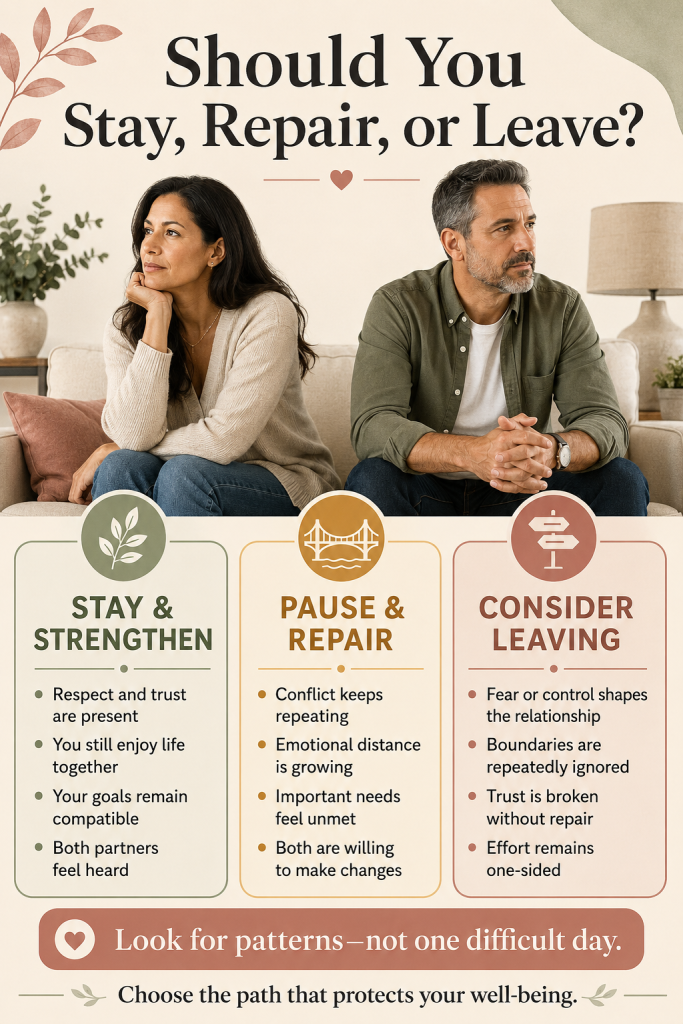
Knowing whether you should stay or leave a relationship is a personal decision. There’s no perfect calculation or right timeline. Healthy love should not feel emotionally unsafe, draining, or hopeless all of the time. The goal of being in a relationship isn’t to have a perfect relationship, but it is about having mutual respect, a strong connection, a partnership, and emotional security.
When these things disappear or stay absent even when putting in effort, letting go might be healthier than holding on to the relationship.
Frequently Asked Questions
1. How do I know if it is time to leave my relationship?
It may be time to consider leaving when disrespect, dishonesty, control, emotional neglect, or repeated boundary violations have become ongoing patterns. Look at how the relationship normally feels rather than judging it by one unusually good or difficult day.
2. Can a quiz tell me whether I should end my relationship?
A relationship quiz cannot make the decision for you. It can help you organize your thoughts, identify patterns, and recognize concerns that deserve attention. Your circumstances, values, safety, and long-term well-being should guide the final decision.
3. What are the clearest signs of an unhealthy relationship?
Common signs include persistent disrespect, controlling behavior, manipulation, broken trust, ignored boundaries, fear of speaking honestly, and one-sided effort. A single disagreement is different from a harmful behavior that keeps repeating.
4. How can I tell the difference between a rough patch and a failing relationship?
A rough patch is usually temporary, and both partners remain willing to communicate and make changes. A failing relationship often involves unresolved problems, declining trust, emotional distance, and little meaningful effort to improve the situation.
5. Is frequent arguing a reason to leave?
Frequent disagreements do not automatically mean a relationship must end. Pay attention to how conflicts are handled. Constructive disagreements allow both people to speak and find solutions, while destructive conflicts involve contempt, intimidation, blame, or repeated personal attacks.
6. Can a relationship recover after trust has been broken?
Trust can sometimes be rebuilt when the person responsible is honest, accepts accountability, changes the harmful behavior, and remains consistent over time. Rebuilding also requires willingness from both partners and cannot depend on promises alone.
7. How do I know whether my partner is genuinely trying to change?
Genuine change appears through consistent actions. Look for accountability, respect for boundaries, improved communication, and dependable behavior over time. Repeated apologies followed by the same conduct usually indicate that meaningful change has not occurred.
8. Should I stay because we have been together for many years?
A long shared history can be meaningful, but time already invested should not be the only reason to stay. Consider the relationship as it exists today and whether it still offers mutual respect, emotional security, companionship, and a workable future.
9. Is losing romantic excitement a sign that the relationship is over?
Excitement naturally changes in long-term relationships. A quieter connection does not necessarily mean love has disappeared. The more important questions are whether affection, friendship, respect, curiosity, and a desire to reconnect are still present.
10. What if I love my partner but feel unhappy?
Love and unhappiness can exist at the same time. Identify what is causing the unhappiness and whether it can realistically change. Love matters, but a sustainable relationship also needs respect, trust, communication, compatibility, and mutual effort.
11. How important are shared goals in a relationship?
Shared goals help partners build a compatible future. You do not need identical interests, but major differences involving family, lifestyle, finances, location, or commitment can create lasting tension if neither person can accept a workable compromise.
12. Should I stay if I am the only person trying to fix things?
One person can improve personal habits, but one person cannot repair an entire relationship alone. Lasting improvement normally requires both partners to acknowledge the problems, communicate honestly, and follow through with appropriate changes.
13. What does emotional distance look like in a relationship?
Emotional distance may appear as reduced affection, avoiding meaningful conversations, feeling lonely together, losing curiosity about each other, or no longer sharing important thoughts. It deserves attention, especially when it becomes a persistent pattern.
14. Can taking a break help save a relationship?
A planned break can provide perspective when both people agree on its purpose, duration, boundaries, and communication rules. An undefined break may create more uncertainty, so expectations should be discussed clearly before spending time apart.
15. How long should I wait for a relationship to improve?
There is no universal deadline. Set specific changes you need to see and a reasonable period for evaluating progress. Small improvements may happen gradually, but serious promises should still produce observable and consistent action.
16. What questions should I ask before ending a relationship?
Ask whether you feel respected, emotionally secure, heard, and able to be yourself. Consider whether both partners accept responsibility, whether the main problems are repairable, and whether staying supports the future you genuinely want.
17. Am I staying because I am afraid of being alone?
Imagine that loneliness, other people’s opinions, and practical uncertainty were temporarily removed. Then ask whether you would still choose this relationship. Your answer may help separate genuine connection from fear-based attachment.
18. Is it normal to have doubts about a relationship?
Occasional doubts are common, especially during stressful periods or major life changes. Doubts deserve closer attention when they remain persistent, center on fundamental incompatibility, or arise from repeated behavior that damages trust and well-being.
19. How can I talk to my partner about my concerns?
Choose a calm time and describe specific behaviors and their effects without making broad accusations. Explain what you need, listen to your partner’s perspective, and discuss practical changes that both of you can evaluate over time.
20. What if my partner dismisses my feelings?
Partners do not have to agree about every event, but they should take each other’s feelings seriously. Repeatedly mocking, minimizing, or dismissing your concerns can prevent healthy communication and may indicate a deeper lack of emotional respect.
21. Can couples counseling repair every relationship?
Counseling cannot guarantee that a couple will remain together. It may improve communication, reveal recurring patterns, support informed decisions, and help willing partners make changes. Its effectiveness depends partly on honesty, participation, and the nature of the problems.
22. When should couples counseling not be the first step?
When someone feels controlled, intimidated, or unsafe, individual support and an appropriate safety plan may be more suitable than joint counseling. Relationship discussions should not place either person at greater risk.
23. Should I leave after betrayal or infidelity?
Betrayal does not produce one correct decision for every couple. Consider whether there is complete honesty, sincere accountability, an end to the harmful behavior, and enough consistency to rebuild trust. You are not obligated to remain while that process occurs.
24. Can different communication styles be repaired?
Different communication styles can often be managed when both people remain respectful and willing to adapt. Improvement may involve clearer requests, better timing, active listening, and agreed rules for handling emotionally difficult conversations.
25. How do boundaries affect the decision to stay or leave?
Healthy boundaries define what each person needs to feel respected and secure. A partner may need time to understand a new boundary, but repeatedly ignoring, challenging, or punishing you for reasonable boundaries is a serious concern.
26. What does a repairable relationship usually look like?
A repairable relationship usually retains basic respect, honest communication, accountability, and willingness from both partners. Problems may be significant, but actions show that both people are prepared to understand their part and work toward change.
27. What are signs that leaving may be the healthier choice?
Leaving may be healthier when the relationship consistently involves fear, control, humiliation, repeated dishonesty, ignored boundaries, or complete unwillingness to address serious problems. Persistent loss of trust and well-being should not be dismissed.
28. How can I make a relationship decision without acting impulsively?
Give yourself time when circumstances allow, write down recurring patterns, identify your essential needs, and speak with a trustworthy person or qualified professional. Evaluate consistent behavior rather than making the decision solely during an intense argument.
29. What should I do if I feel unsafe ending the relationship?
Do not feel required to end the relationship privately or in person. Contact a trusted adult, qualified local support service, or emergency service when immediate protection is needed, and make a plan suited to your circumstances before announcing your decision.
30. What should I remember after completing the love quiz?
Treat the results as a reflection tool rather than a final verdict. Focus on repeated patterns, trust your direct experiences, consider your well-being, and seek appropriate support when the decision feels confusing or difficult.