

Finding the best psychics online starts with a personal question: what kind of conversation are you looking for? You may want to explore a relationship pattern, reflect on a change or make space for a spiritual question. A clear purpose makes it easier to compare readers without being swept along by a long list of promises.
Look at both the reader and the service around them. The method, communication style, full cost, privacy rules and ability to stop all affect your experience. You can value intuitive guidance while asking straightforward questions before you spend.
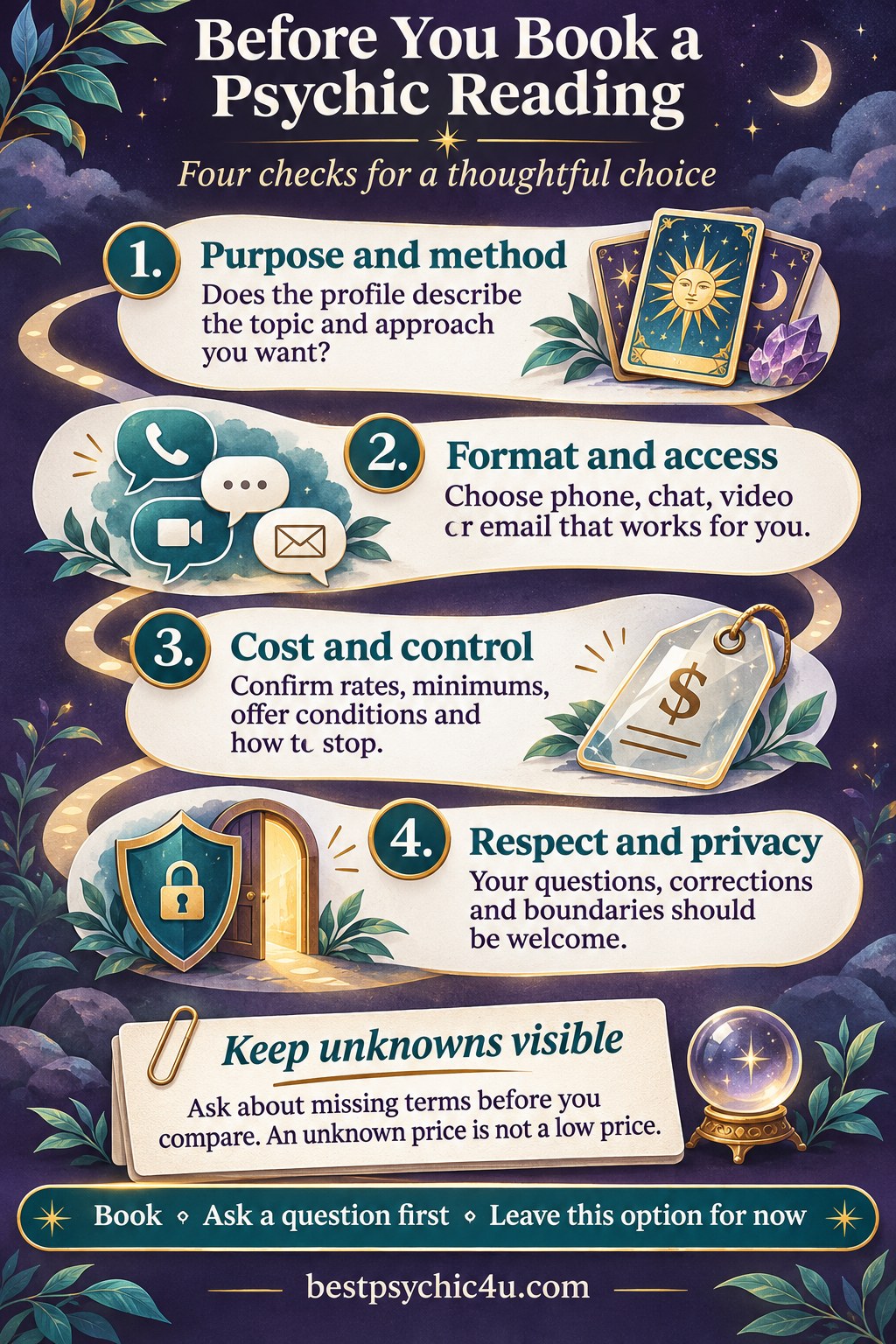
Four checks before you book
Does the profile describe the topic and approach you want, such as tarot, astrology or an intuitive conversation?
Can you use the offered channel comfortably, and is the reader actually available at a suitable time?
Can you see the total charging rules and stop before passing your limit?
Are your questions welcome, your boundaries respected and your information handled in a way you accept?
Choose the reading method separately from the channel
A phone call, live chat, video call and email are ways to communicate. Tarot, astrology, mediumship and clairvoyant or intuitive readings describe approaches a reader may use. A tarot reader may offer phone sessions; an email appointment may contain a written interpretation of cards. Check the specific profile rather than assuming a format determines the method.
Tarot often centers on card imagery and symbolic interpretation. Astrology may use birth information to discuss chart symbolism. Mediumship is offered as a spiritual attempt to connect with someone who has died; it cannot promise contact or closure. Intuitive readers describe impressions in their own terms. Ask what you will receive, what information is needed and what the reader does when an impression does not fit.
Our guide to choosing a reader’s style can help you think about the individual conversation. If you prefer typing, the live chat guide covers questions to ask about that format.
Read reviews for specific behavior
A useful review tells you something concrete: the reader explained their approach, kept to the agreed topic, welcomed a correction or made the price clear. Read more than the most enthusiastic testimonial, and notice recurring complaints about billing, pressure or difficulty contacting support.
Do not confuse satisfaction with a verified prediction. A person may feel comforted by a session while a factual statement remains uncertain. The FTC’s online-shopping advice recommends checking sellers, considering reviews critically, reading terms and keeping purchase records. Those habits also help when comparing an online service.
Find out what “screened” actually means
Identity checks, interviews, sample readings and ongoing customer feedback are different things. A profile saying “verified” is incomplete information unless the service explains the check. Our advisor-screening guide breaks down those distinctions.
Training and experience can tell you about a reader’s background, but they do not guarantee that a statement is correct. Avoid treating professional presentation, an expensive rate or a large following as proof. Equally, a bright advertisement does not by itself show that someone is dishonest; examine what is promised and how the service behaves.

Compare the full cost, including introductory offers
Before starting, check the rate, minimum session length, time rounding, connection charges, introductory eligibility and what happens when promotional credit ends. Look for subscriptions, automatic top-ups and any separate charge for a follow-up message. A “free” headline is not enough to tell you what you may be billed.
For a hypothetical rate of $3 per minute, a 15-minute session costs $45 before any other applicable charges. Use the actual rate shown for the reader you choose. The reading-budget guide helps you set both a session limit and a wider spending boundary.
If you want to compare services after making your checklist, our service comparison featuring PsychicOz is a starting point. Confirm current terms at the point of booking, because a directory listing or article cannot lock in an offer.
Free reader comparison sheet
Copy this list into a private phone note for each reader on your shortlist. Keep unknown answers visible instead of filling them in with assumptions.
- My purpose: One question I want to explore.
- Reader and method: What the appointment includes and what it does not promise.
- Channel: Phone, chat, video or written reply; timing and accessibility needs.
- Price: Rate, minimum, promotional conditions and maximum planned spend.
- Privacy: Information requested, transcript or recording rules and account visibility.
- Service terms: How I stop, report a connection problem or raise a billing concern.
- Communication: Whether questions, corrections and “I do not want to discuss that” are accepted.
- Decision: Book, ask a question first or leave this option for now.
Example: Reader A offers the method you want, but the standard rate after the promotion is unclear. Reader B states a clear rate and format. Ask A for the missing terms before comparing; an unknown price is not a low price.
Protect your privacy before the conversation
Online does not automatically mean anonymous. A service may collect account, payment and device information even if you use a screen name. Check who can access messages or recordings and whether you are comfortable with the retention and deletion rules. Use a private location and an account you control.
You can name a topic without supplying passwords, identity documents, intimate photographs or someone else’s private messages. Ask before recording a session. If a reader needs birth information for astrology, decide whether you want to share it and whether an approximate or limited discussion would suit you better.
Go into the first session with one clear question
Try “What patterns would I like to change in how I approach dating?” or “Which priorities should I reflect on while considering this job change?” These invite a useful conversation about your experience. Keep decisions grounded in direct communication, actual job details and other information you can check.
You do not need to suppress doubt or accept a statement to be a good client. If something does not fit, say so. After the session, note what you found useful, what remained unclear and one small practical action. Give yourself time before deciding whether another appointment is worthwhile.
Frequently asked questions
1. Who are the best psychics online?
The best fit depends on your purpose, preferred format, budget and communication needs. Compare specific reader profiles and service terms instead of assuming that a top position or star rating proves accuracy.
2. How do I know whether a psychic is accurate?
A reassuring feeling or a strong review does not establish accuracy. Keep the exact statement, what you already knew and the eventual outcome separate. A prediction may be wrong or remain uncheckable.
3. Can I have a reading if I am skeptical or nervous?
Yes. You can be curious while asking clear questions and keeping your own judgment. Nervousness or disagreement does not make you responsible for a reading that does not fit.
4. Is chat better than a phone reading?
Chat may suit someone who prefers writing or needs a text format; phone allows a spoken conversation. Video adds a visual connection, and email is usually asynchronous. Availability, accessibility and terms vary.
5. Is tarot different from a psychic reading?
Tarot uses cards and their imagery as a central method. A reader describing a psychic session may use tarot or another approach. Ask what the appointment actually includes.
6. Can I ask about love or work?
You can explore your own feelings, priorities and next steps. A reading cannot establish another person’s hidden thoughts or replace direct communication, employment information or qualified professional advice.
7. Are free psychic readings really free?
An offer may provide limited introductory minutes or credit with eligibility rules. Check whether a payment method is required, when billing begins, the standard rate and whether any recurring payment is enabled.
8. Do screening and verification prove psychic ability?
No. Screening might refer to identity checks, interviews, sample sessions or customer-service rules. Find out which checks are actually described; the label alone does not certify paranormal accuracy.
9. How much background should I share?
Agree on the style before starting. You may name a broad topic, give a little context or ask to hear opening impressions first. Share only what you are comfortable disclosing.
10. Will my online reading be anonymous?
A screen name does not guarantee anonymity. Read what the platform collects, whether it stores chats or recordings, who can access them and how deletion requests work.
11. Should I trust reviews and testimonials?
Use them as one source of information about communication and service. Read several sources and look for specific patterns; ratings can be incomplete, incentivized or misleading.
12. How long should my first reading be?
Choose a length you can comfortably afford and use for one focused topic. Confirm minimum charges, rounding and the stopping procedure before the session.
13. What if the reader’s statements do not fit?
Say so, ask for clarification if you wish and avoid inventing a match. You can end the session under the service’s terms and contact support about a billing or service concern.
14. Is expensive pricing or flashy advertising a sign of a fake psychic?
Neither price nor appearance reliably identifies someone’s abilities or conduct. Clear terms, respectful behavior and freedom from pressure are more useful things to examine.
15. What should I do after a reading?
Keep a brief private record, identify one practical next step and allow time before buying another session. Check important claims against ordinary evidence and retain receipts for any service issue.